Jerusalem ceramicist carries a family tradition into its fourth generation
Patil Karakashian balances chemistry studies with ceramic work in her family’s Old City workshop, continuing a craft brought to Jerusalem by her great-grandfather in 1919.
By News Media House Staff ·
For Patil Karakashian, the ceramic street signs of Jerusalem’s Old City are a daily connection to her grandfather. Now 24, she is creating signs of her own while working alongside her parents in a workshop in the Christian Quarter. A fourth-generation Armenian ceramicist, she is helping sustain a family craft that has been part of the city for more than a century.
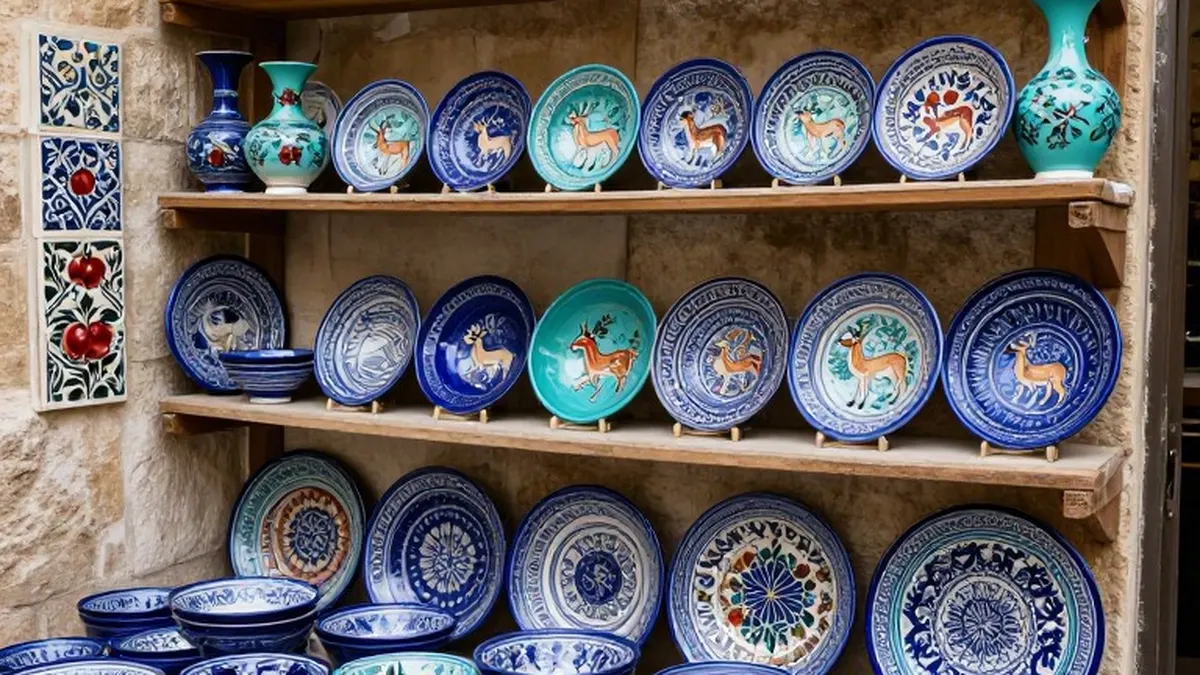
The workshop occupies a centuries-old Ottoman building on Greek Patriarchate Way. Its shelves hold hand-painted cups, bowls, plates, vases and tiles, with cobalt blue and turquoise among the prominent colors. Gazelles, flowers, pomegranates and elaborate patterns decorate the pieces. Her father, Hagop, learned the craft in childhood, while her mother, Tzoghig, contributes paintings and variations on traditional designs.
The family’s connection to Jerusalem began in 1919, when Karakashian’s great-grandfather, Megherdich, came from Kütahya, in present-day Turkey. He arrived with members of the Ohannessian and Balian ceramic families after the British administration recruited them to restore tiles at the Dome of the Rock. That project did not go ahead as planned, but the families remained and established workshops. The Armenian Genocide had made a return to their previous lives increasingly difficult.
In 1966, Jordanian authorities commissioned her grandfather, Stepan Karakashian, to make street-name signs for the Old City. He surrounded Arabic and English lettering with yellow borders decorated with olive leaves. After the 1967 Six Day War, then-mayor Teddy Kollek asked him to add Hebrew. According to Patil, Kollek helped Stepan, who could neither read nor write the language, get the lettering right. The Hebrew was added above the existing names, with a dividing line still visible on many signs.
Patil began learning to paint from her grandfather at five. Drawing lessons followed when she was about 13 or 14, although she initially found that work difficult and often returned to painting. She now particularly enjoys larger projects, including murals and street signs. She recently finished a ceramic sign for the Notre Dame building outside the Old City and hopes to secure further commissions.
Alongside her ceramics, Karakashian studies chemistry at Jerusalem’s Hebrew University. She works in the studio during summers and on Fridays and Saturdays during the academic year. Her interests overlap in the pigments, glazes and chemical reactions involved in firing ceramics. Dark blue is her favorite color, partly for its transformation from a soft purple before glazing and firing into its finished shade.
The studio also brings together Israelis, Palestinians, clergy and tourists, who visit to shop, paint or talk. Karakashian and her father teach painting classes for different ages, explaining how mineral powders develop richer colors in the kiln. A teacher from a nearby Greek school exchanges Greek lessons for Armenian instruction from the family. Patil herself speaks Armenian, Arabic, English, Hebrew and German.
Passports, photographs, documents and older ceramics preserve the family’s history inside the workshop. Pieces marked with names from different periods of Jerusalem’s past sit alongside contemporary work bearing the Karakashian name. For Patil, that inheritance also remains visible beyond the studio, where her grandfather’s signs continue to guide people through the Old City and inspire her own work.
Originally published by News Media House